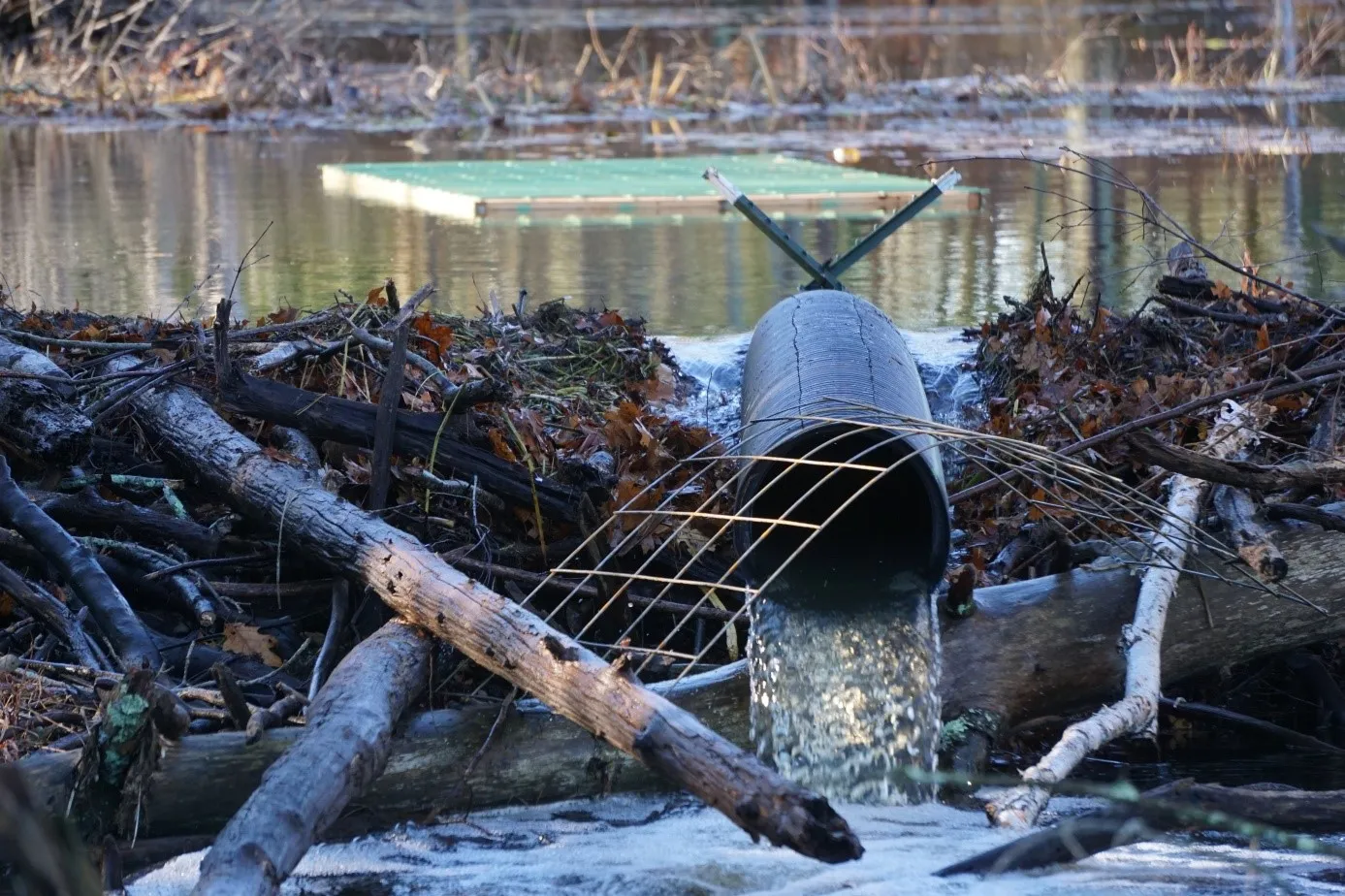
Beaver deceiver
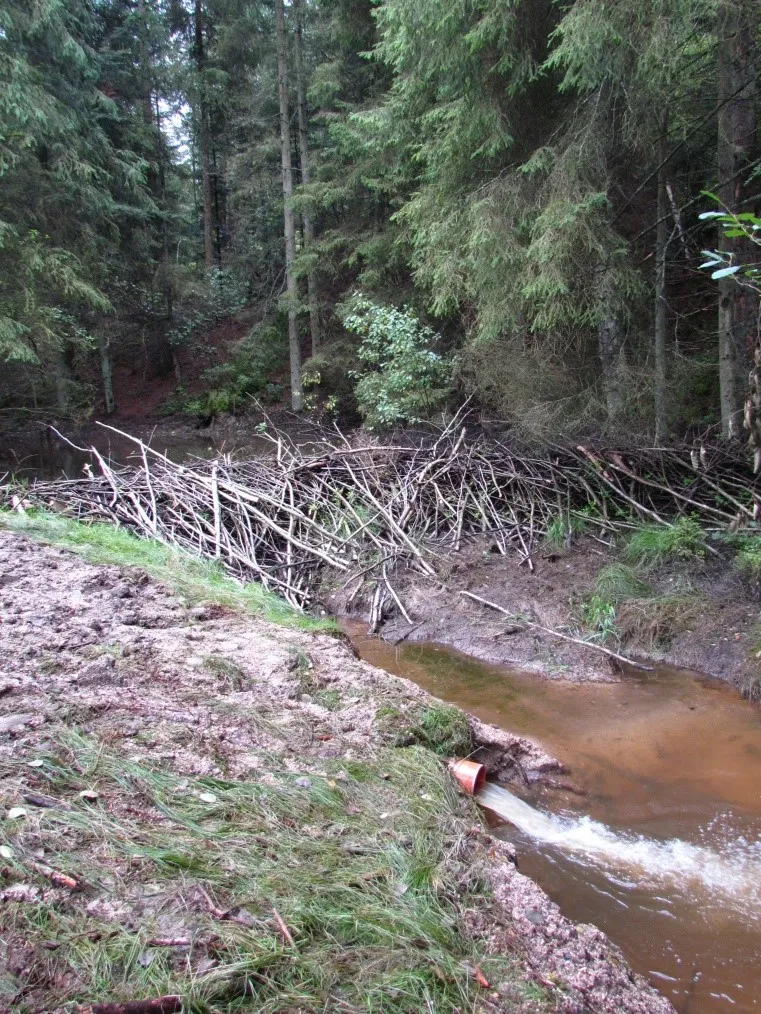
When a beaver dam causes changed water levels a beaver flow device/ deceiver may mitigate potential impacts by allowing water flow through the dam.
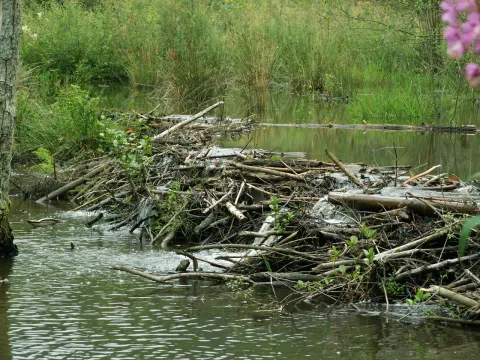
© S. Vreugdenhil
Page content
If a beaver builds a dam or blocks a culvert and this causes conflict and/or damage, a beaver flow device/ deceiver may offer a solution. Flow devices allow water to pass through or around beaver dams so that beavers can remain in an area while also protecting property and preventing damage. There are several techniques and variations, but most methods combine the use of pipes for water carrying and fencing for beaver exclusion.
Goal
- Regulate water level and prevent flooding.
- Reduce or prevent beavers from ‘repairing' or plugging the structure.
- Minimise or hide cues (sound, feel) that provoke beaver damming behaviour.
None of the methods are a one-size-fits-all. The length, diameter, spacing, fence dimensions, and layout must be adapted to the particular dam, flow rates, pond depth, etc. For the best results, prior experience or advice from an expert is recommended.
Materials
A double-walled polyethylene (PE) pipe is commonly used.
- Diameter: 25 and 40 cm, depending on the volume of water to be discharged.
Pipe length: 10 to 15 metres is recommended.
The further the inlet of the pipe is from the dam, the higher the chance of success.
Double-walled pipes offer better stability and hydrodynamic performance than single-walled pipes, helping them to stay in place more easily.
To prevent double-walled pipes from floating, holes should be drilled at regular intervals through both walls.
It is also possible to use PVC pipes, however, in larger diameters (≥ 30 cm) PE pipes are significantly lighter and easier to install.
Installation
Dig a trench through the dam to lay the pipe.
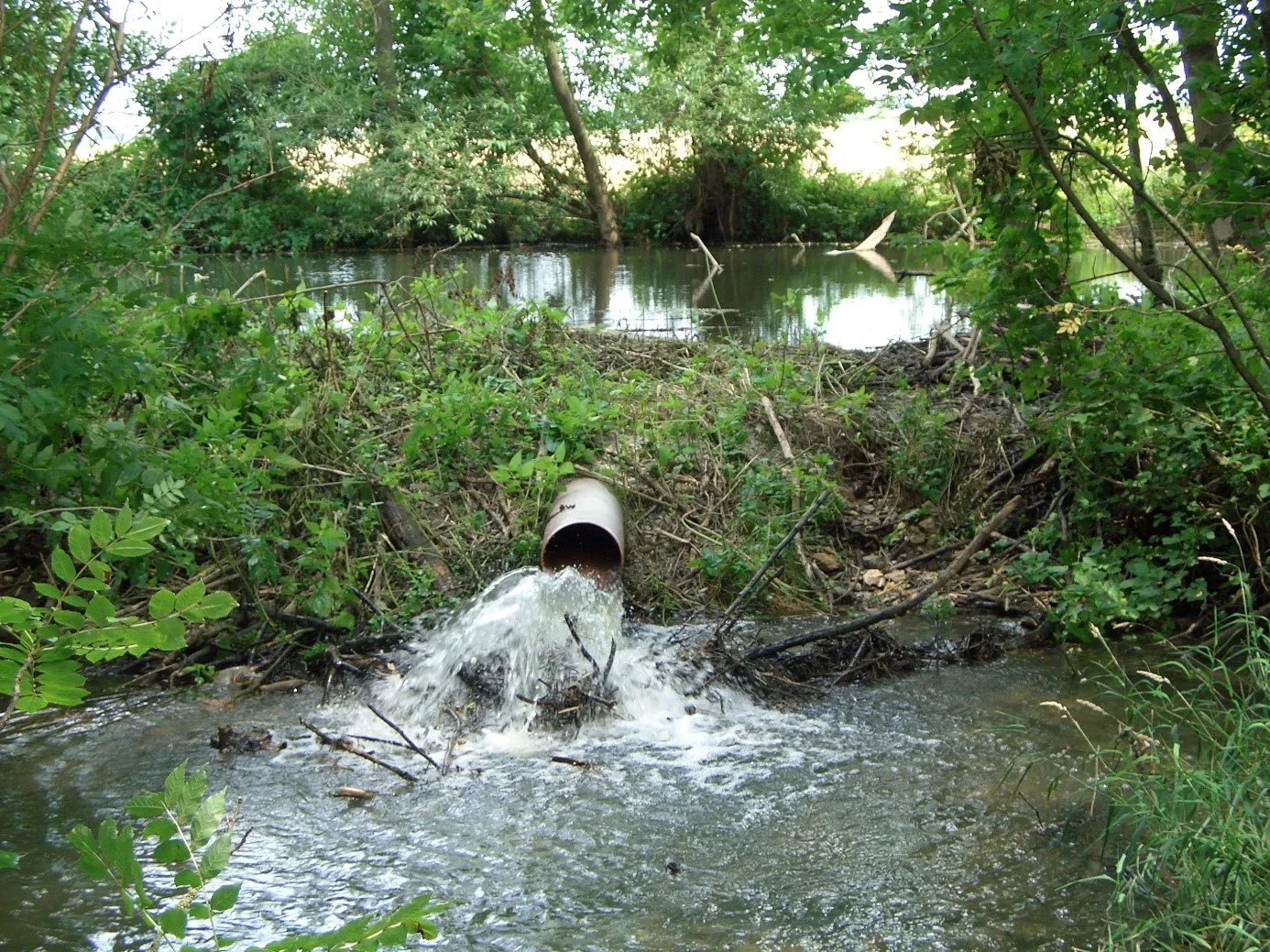
Position the pipe at the desired water level, allowing the downstream end to extend about 50 cm past the dam (Figure 1). This places the inlet far enough from the dam to prevent detection or blocking by beavers.
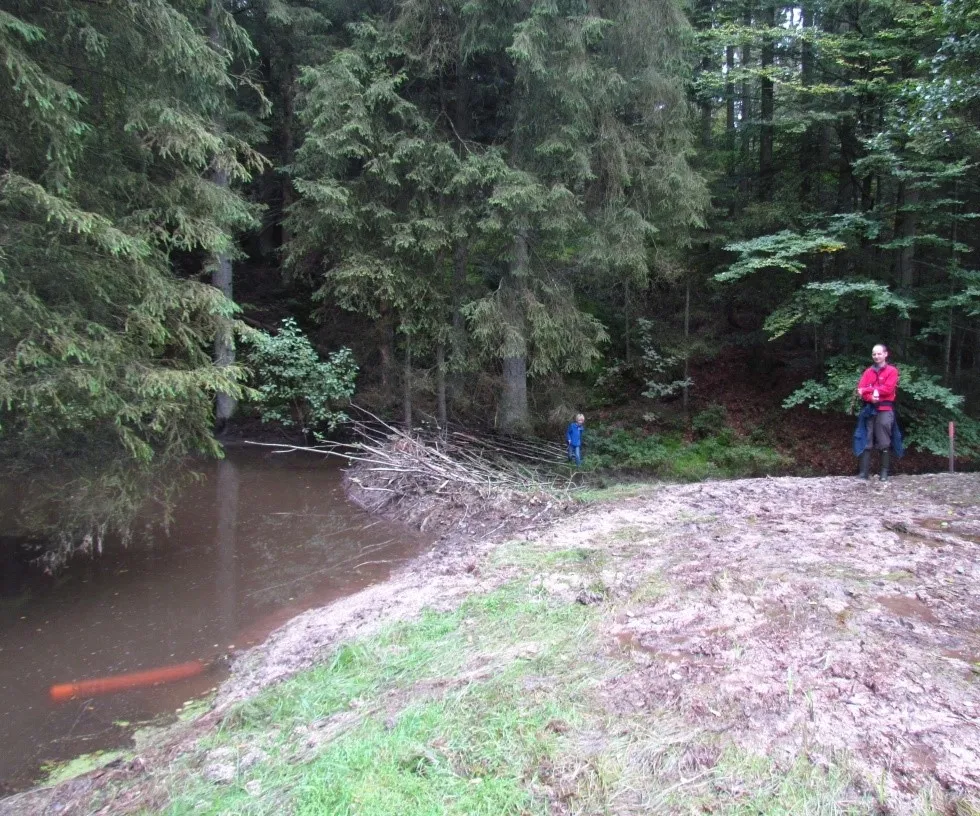
Sometimes a bypass pipe placed alongside the dam is more effective (Figures 2 and 3).
Mount the filter securely over the pipe inlet to ensure that it stays centered and in place.
Ensure the pipe is fixed to the streambed midway along its length, especially when using flexible PE pipes.
Pipe inlet filter
To prevent beavers from accessing the pipe's inlet, it should be enclosed with a filter.
- The filter is made from 15 x 15 cm mesh, with a wire thickness of ~5 mm.
- Avoid smaller mesh sizes to reduce clogging by floating debris.
- The shape can be cylindrical or square, but must fully enclose the pipe inlet.
- Filter size depends on the width of the watercourse and the pipe, typically between 1 and 2 metres.
Perforated pipes
In some cases, a perforated pipe can be used instead of a filter (such as the Clemson Beaver Pond Leveler). This design involves creating multiple small holes in the upstream section of the pipe, allowing water to enter at several points along its length.
Adjusting water levels
If seasonal water level variation is needed, an adjustable elbow joint can be placed at the inlet which allows the water level to be raised or lowered as needed.
If one pipe cannot handle the full water volume, a second pipe can be installed alongside the first. In cases of consistently low flow, a smaller diameter pipe may be sufficient.
Covering the outlet
If water exits the pipe and creates a small waterfall, beavers may respond by damming the outlet side. This can be prevented by placing a slightly curved horizontal mesh over the outlet to block access (Figure 4).